
By Ankit, GreensWale Delhi
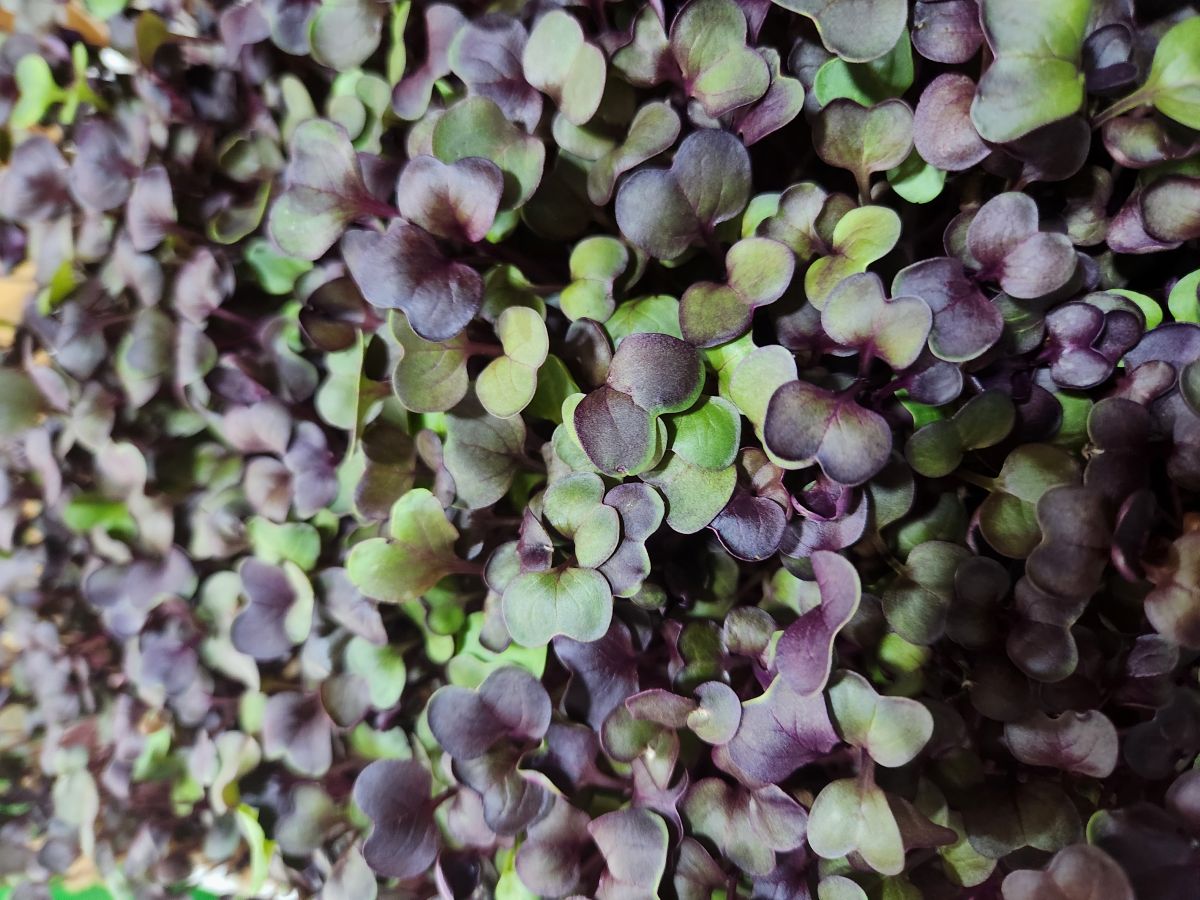
The first time I looked at a tray of Purple Sango ready to harvest, I genuinely stopped and did nothing for a few seconds. That's not something that happens often when you're running a farm. The leaves were deep magenta fading into green at the stem, and the entire tray looked like something a painter had worked on rather than something that had just grown in our Delhi grow room over the past ten days.
I've been growing microgreens for a while now, and I still think Purple Sango Radish is the most visually striking thing we produce. But what I've come to appreciate even more is that the colour isn't decoration. It's information. Every bit of that pigment is doing something real inside your body.
This is the story of that variety, what's inside it, and why it earns a permanent spot in our grow room.
Purple Sango is a specific cultivar of radish (Raphanus sativus) bred for its intense anthocyanin content. Unlike standard radish microgreens, which lean toward a more uniform green, Purple Sango develops a concentrated purple-red pigmentation in the cotyledon leaves. The colour is strongest at harvest, around day 8 to 10, and begins to dilute if you let it grow longer.
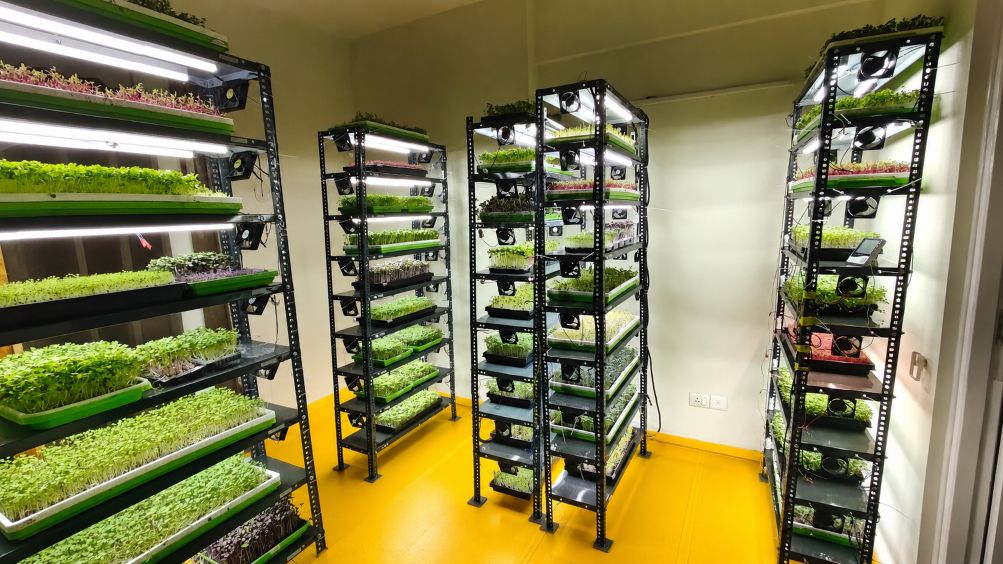
We grow it in cocopeat under a controlled blackout period during germination, then expose it to indirect light for the final few days. That light exposure is what triggers the full anthocyanin expression. The plant is essentially responding to light stress by producing more pigment. The same mechanism is why autumn leaves turn red: a burst of anthocyanin production as conditions shift.
It's one of the reasons I've always felt that microgreens are more alive than people realise. They're actively responding to their environment, right up until the moment we cut them.
Anthocyanins are water-soluble pigments that belong to the flavonoid family of polyphenols. They're responsible for red, purple, and blue colours across the plant kingdom: think red cabbage, blueberries, jamun, and the skin of purple sweet potato.
In Purple Sango Radish microgreens, the dominant anthocyanins are cyanidin-3-glucoside and pelargonidin derivatives. These compounds have been studied extensively for their role as antioxidants, meaning they can neutralise free radicals that contribute to cellular damage over time.
But here's what I find more interesting than the general "antioxidant" label, which gets overused to the point of meaning nothing: the specific mechanisms.
Anthocyanins have shown in multiple studies to modulate NF-kB, the signalling pathway that controls inflammatory gene expression. When NF-kB is chronically activated, it's associated with conditions from metabolic syndrome to certain autoimmune conditions. Anthocyanins appear to act as a brake on this pathway, not eliminating inflammation (which is necessary for normal immune function) but reducing its chronic, low-grade version.
A 2019 review published in Nutrients found that dietary anthocyanin intake was associated with measurable reductions in circulating CRP and IL-6, both markers of systemic inflammation, across multiple population studies. The effect was dose-dependent, meaning more consistent intake corresponded to greater reductions.
What this means practically: a small amount of Purple Sango in your daily meals isn't going to act like a drug. But consistent, daily inclusion over weeks and months does something meaningful to the inflammatory baseline your body operates at.
Radish belongs to the Brassicaceae family, the same plant family as broccoli, mustard, and arugula. This means Purple Sango brings not just anthocyanins but also the glucosinolate chemistry that the whole family is known for.
The primary glucosinolate in radish microgreens is glucoraphenin, which converts to raphanin (an isothiocyanate) via the enzyme myrosinase when the plant tissue is disrupted. Chewing does this naturally.
Raphanin has demonstrated antimicrobial properties in vitro and has been studied for its role in digestive health, specifically as a compound that may help regulate the gut microbiome by selectively creating an environment less hospitable to pathogenic bacteria.
The peppery taste you notice when you eat Purple Sango is not added. It's the isothiocyanate release on chewing. Some people taste it as sharp and spicy, others as mild and peppery. The intensity corresponds directly to how the myrosinase enzymes are activated during tissue disruption. This is also why chewing microgreens rather than blending them tends to preserve more of the isothiocyanate activity.
If you're curious about glucosinolate chemistry in depth, we go into it more in our Broccoli Microgreens post, which covers the sulforaphane pathway in detail. Purple Sango and broccoli work through related but distinct mechanisms, and combining the two on the same plate gives you complementary glucosinolate profiles.
Microgreens are not a meaningful source of macronutrients. That's not what they're for. A 100g serving of Purple Sango won't give you significant protein or carbohydrates, and you don't eat 100g at once anyway. You eat 20 to 30g as part of a meal.
What they do deliver at that serving size is a concentrated hit of micronutrients and phytochemicals. For Purple Sango specifically, relevant micronutrients include:
Vitamin C: Radish microgreens carry a reasonable vitamin C concentration, with research on radish microgreens showing values in the range of 40 to 70mg per 100g depending on cultivar and harvest conditions. Vitamin C in brassica family microgreens also plays a secondary role in maximising glucosinolate conversion to isothiocyanates by inhibiting the ESP (epithiospecifier protein) pathway, which would otherwise divert glucosinolate breakdown toward a less bioactive compound.
Folate: Present at meaningful concentrations, relevant for those monitoring folate intake for hormonal health, pregnancy preparation, or general cellular repair.
Potassium and calcium: In the ranges typical for leafy vegetables, though not a standout versus mature leafy greens on these markers.
The case for Purple Sango is not "eat this instead of your other vegetables." It's "eat this alongside them because the phytochemical profile does things your other vegetables don't."
We grow Purple Sango in our Delhi grow room on a 10-day cycle from seed to harvest. The seeds go into cocopeat at a fixed density, get covered for the germination period, then get exposed to light for the final 3 to 4 days.
Harvest happens the same morning your order leaves our farm. From cut to your door is typically 4 to 8 hours.
This timing matters because anthocyanins begin to degrade after harvest, particularly with heat exposure or UV light. We pack the microgreens in insulated cold packaging precisely to preserve both the pigment and the live enzymes. What you receive is not something that was harvested days ago and kept in a cold store. It's the same day's growth.
If you want to understand more about how the harvest-to-delivery window affects nutritional value across all our varieties, that's something we've written about in the GreensWale growing philosophy post.
The colour is the first thing people notice. The taste is the second. If you've never eaten radish microgreens before, the mild peppery bite can surprise you. It's pleasant, not aggressive, more like a well-dressed salad green than the sharp heat of raw radish.
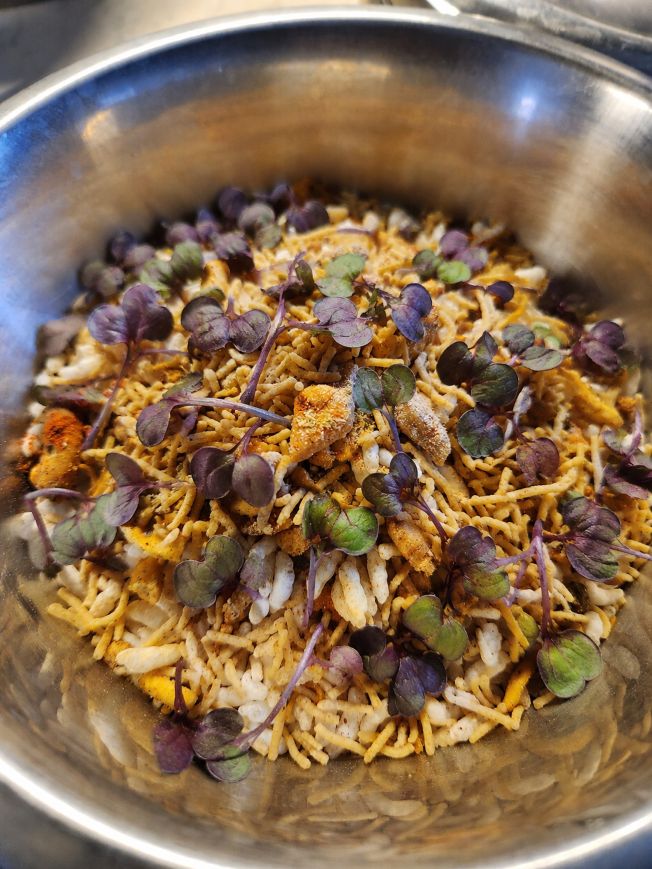
On eggs in the morning: Three tablespoons of Purple Sango on scrambled or poached eggs. The heat from the eggs starts to wilt the microgreens slightly, which softens the texture without destroying the enzymes as rapidly as cooking would. This is probably the simplest daily use.
On dal or sabzi at lunch: We use them as a finish on cooked dishes at room temperature, added after the dish comes off heat. The warmth of the food opens up the peppery aroma without cooking the greens. A small handful over yellow dal with a squeeze of lemon is a genuinely good combination.
With kefir as a gut-focused pairing: Microgreens provide the polyphenol and glucosinolate input. Water kefir provides the live cultures that improve how the gut environment processes those compounds. We've started calling this combination the functional food pairing, and for people with gut health as a specific goal, it's become our most recommended daily routine. If you're curious about how these two work together, the water kefir and microgreens pairing post explains the mechanism.
In a smoothie: Add 15 to 20g to a green smoothie. The colour turns the drink a deep pink-purple. The anthocyanins from Purple Sango interact interestingly with the vitamin C in fruits like amla or kiwi, both of which are common in functional smoothies. Blending breaks down the myrosinase more than chewing does, so you lose some isothiocyanate activity, but the anthocyanins survive fine.
On top of hummus, curd, or a raita: As a garnish that pulls double duty. The visual impact is immediate and the flavour works with dairy and legume bases.
Keep refrigerated, unwashed. We send them in a sealed kraft punnet or sealed pouch.
Best window: 3 to 4 days from harvest for peak phytochemical concentration and colour. Still safe and good to eat up to 7 days refrigerated. Wash just before eating, not before storage. The moisture from washing accelerates cell breakdown.
Purple Sango is a Standard variety and available on our weekly order cycle. You can order as a single-variety 100g pack, or include it as one of up to three varieties in a custom mix starting from 250g.
We grow on pre-booked cycles, so same-day orders depend on availability. For guaranteed fresh packs, join our standing weekly order. You can set it up on WhatsApp at +91 9211986823.
FSSAI Registration: 13325006000511
If Purple Sango has you curious about what else we grow, here's where to go next:
For sulforaphane depth: Broccoli Microgreens is the strongest NRF2 activator in our range. The science behind it is worth reading if inflammation or metabolic health is a priority.
For the most striking flavour contrast to Purple Sango: Arugula Microgreens has an intense nutty-peppery character and a very different glucosinolate profile.
For the mildest, most versatile daily green: Sunflower Microgreens is what we recommend for people new to microgreens, or for those building a base layer in a bowl or salad.
For something functional in a completely different category: Our Daily Greens Powder concentrates Broccoli, Mustard, Radish, Chia, and Flax into a 2g daily serving for people whose routines don't accommodate fresh greens every day.
I started this post by describing what it felt like to look at a tray of Purple Sango before harvest. I think the thing that strikes me is that the colour is not cosmetic. Plants don't invest in pigment without reason. Every bit of that anthocyanin is a response to something: light stress, the plant's own oxidative environment, a biochemical negotiation with the world around it.
When you eat it, you are eating the record of that negotiation. The compounds that helped the plant manage stress have measurable effects on how your own cells manage theirs.
That's not marketing. That's just how plant chemistry works. We just try to harvest it at the moment it's most concentrated, and get it to you before it starts to fade.
GreensWale grows fresh microgreens and brews water kefir daily in Delhi. All orders are harvested the same morning they are delivered. To place an order or ask a question, WhatsApp us at +91 9211986823.
FSSAI Registration: 13325006000511